

After leaving the second-highest civilian position in the Department of Defense, Kathleen Hicks could walk her dog without security trailing her. She could drive herself places. And, if she wanted, she could go to TJ Maxx. Those were her words when I talked to her about that first week: “little expressions of freedom is the honest answer.” After four years as Deputy Secretary of Defense, freedom meant a retail store and a walk around the block alone.
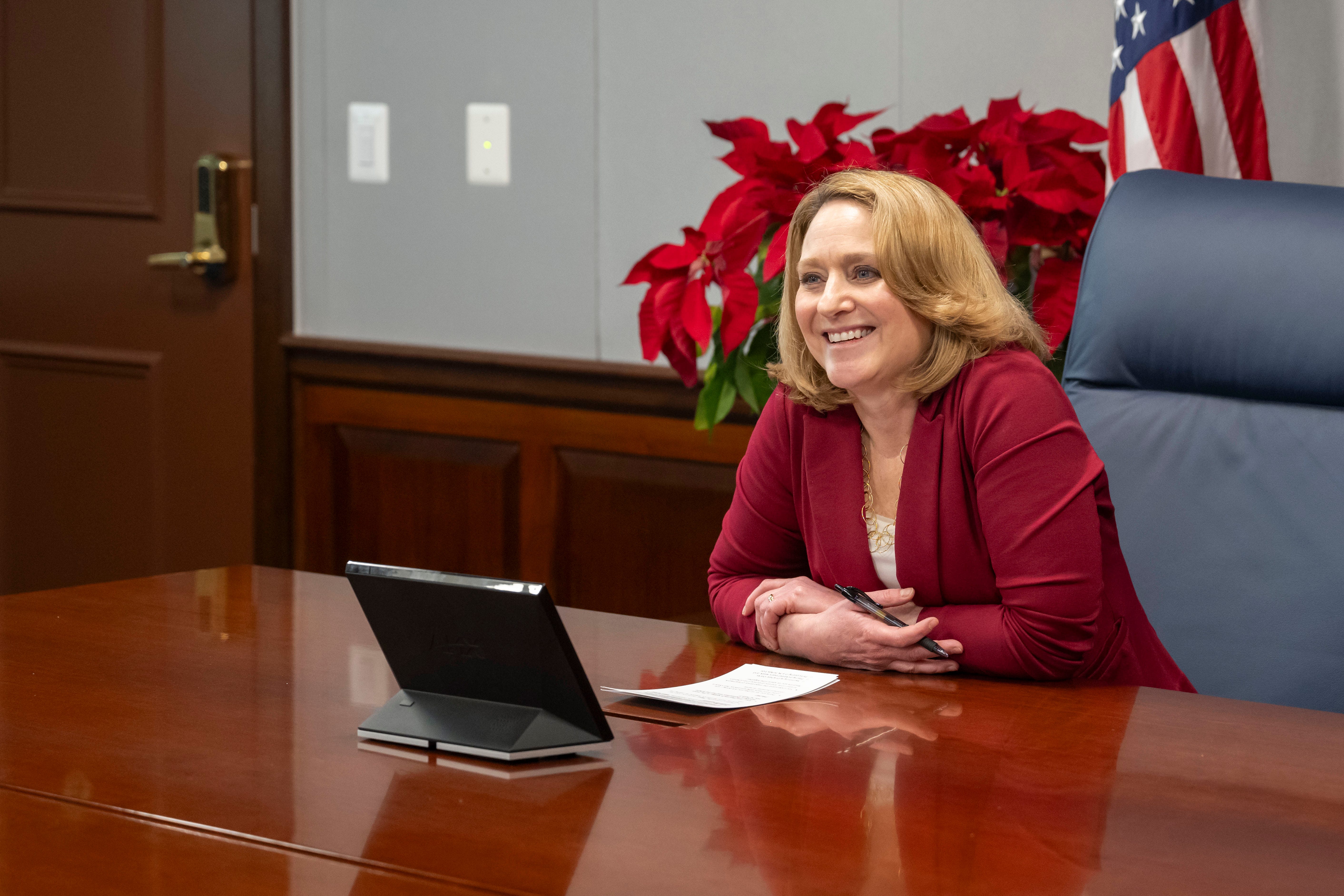
I wanted to start there because it says something genuine about the real cost of that job. The security bubble required at that level is significant. You don’t wander anywhere without people who know where you are. And then the administration changes and all of it vanishes. The question of how to readjust is not rhetorical. It’s a genuine logistical problem that only a very small number of people ever have to solve.
Kathleen solved it because it wasn’t her first time.
She left government in 2006, then came back. She left again in 2013, and came back again. She left in 2025. First Senate-confirmed woman to become Deputy SecDef. Highest-ranking woman in Department of Defense history. Each exit, she says, was easier than the last. Not because the stakes got smaller. Because she had a frame for it that held.
The job was never hers to keep.
When she arrived as Deputy Secretary, there was a physical baton waiting for her. A literal one, passed down from the prior Deputy as a ceremonial handoff. She carried it through four years of crisis management, AI investment decisions, workforce reform fights, and a war in Ukraine. When she left, her successor hadn’t been confirmed yet. So she did what the tradition required. She set the baton on the desk and walked out.
She told me about Bob Gates’s memoir. The title is “Duty.” She keeps it on a shelf, and she said that if you really believe in the mission, the framing takes care of itself: “they weren’t yours ever. For the keeping, you’re there as a caretaker.” She’d built her entire tenure around institutional endurance, not personal legacy. So when January 20th came and the job was simply gone, she already had the language for what that meant.

“If you really believe what you’re doing is duty and not yours to own, you’re ready for that handoff when it comes.”
I don’t know what it takes to hold that frame under the actual weight of that role. I’ve been in the same building. I’ve watched what it does to people who work much smaller versions of it. What I saw from her across those years was someone who didn’t confuse the title with the person. That’s rarer than it sounds at that level.
She was born the youngest of seven children in a military family. Her father served. Several of her siblings did too. Her mother spent years supporting the spouse and family communities for the Navy. Public service wasn’t something she discovered in a poli-sci classroom. It was the operating system of the household. Those kitchen table conversations, the siblings home from college, the debates about policy and the world, were the places where she learned to want in. She was the youngest. The older kids were already at the serious table. So she prepared herself to sit there. She used those words exactly: “I wanted to sit at the big kid table.”
She double-majored in history and political science. Then a master’s in public policy. Then a PhD in international relations and security studies. She said she’s always been drawn to both the theoretical and the practical, and she doesn’t trust one by itself. Big ideas need to hit the ground eventually. She started as a Presidential Management Fellow in 1993 in the Office of the Secretary of Defense and spent the next 13 years as a career civil servant working on policy and strategy across multiple administrations and political parties. The first time she left, in 2006, it was on her own terms with a job waiting. The second time, in 2013, she was a Senate-confirmed political appointee departing the Obama administration without a clear next step. She took some time to figure it out. Both times, she landed somewhere that let her keep working the same mission from outside the building.
She described those transitions as progressively giving her more agency. The first felt like a leap from stability. The second felt open-ended but manageable. This last one, at the level she was operating, came with the most freedom she’d ever had to choose what comes next. And the most to walk away from.
I asked about imposter syndrome because it comes up constantly in this show, and I wanted to hear what she’d say.
She doesn’t have it.
“I have worked really hard in this career. I didn’t shoot to the top.” When people find her credible, she accepts it. When they don’t, she checks herself first, then decides whether the gap is hers to close or theirs: “maybe it’s on me. Maybe I’m not listening. Maybe I did something wrong. But also maybe it’s on them.” That’s a different relationship to doubt than most people I’ve talked to. It isn’t the absence of self-examination. It’s self-examination that doesn’t collapse into self-erasure.
Her answer on confidence surprised me more. She didn’t describe it as something she built or a skill she trained. She described it as a byproduct of humility. Listening to the experts. Admitting what you don’t know. Letting the people who actually understand AI or drone logistics or civil service law do the explaining. Then synthesizing what you’ve heard into a direction the institution can move. “The confidence should never be” untethered from that, she said. It “should come from the humility.”
One of the military officers who had worked with the prior Deputy and stayed on asked her directly what it felt like to be first. She told him honestly: “I don’t really think about it. I’m worried about what needs to get done.” Being who she is, the youngest of seven, a woman, a career civil servant who came up without an operational background, all of it goes into how she does the job. She doesn’t run from it and she doesn’t perform it. It’s part of what she brings into every room.
What she left worried about was the workforce.
Civil service reform is something she describes as unfinished. She couldn’t move it as far as she wanted before the clock ran out. She used the phrase “the political clock” to name the real constraint on anything ambitious inside government: “you never fool yourself that you’re gonna have longer than four years.” So you plan four years of work, get through most of it, and accept that some things get handed to the next person still in progress.
What she didn’t plan for was DOGE.
She said it plainly: “I couldn’t have imagined that risk exactly.” She’d stress-tested a lot of scenarios. She knew substantial workforce reductions were likely, but she did not anticipate it occurring with so little analysis of its economic and national security consequences. There were areas of concern when she walked out. What happened next was different in kind from what she’d anticipated.
I asked what she’d say to a young person three years into a federal career right now, wondering whether it’s worth staying. She said the answer will always be context dependent. The core question she’d push them toward: “am I able to make a difference? Am I contributing to what feeds me?” She was in the Pentagon on September 11th. She’s worked inside the Department through its worst institutional moments and its most innovative ones. Her sense of what staying and building inside a hard institution can do for a person is informed by all of it.
Now she’s working again outside government, still oriented toward national security, still serving the mission she described as the through line across all three of her exits.
The baton is on the desk. Someone else is holding it now, or will be soon. That’s how she built it to work.
She isn’t shaken by it. When I asked how it felt to watch someone else pick up the baton, she said that was always the point — you build the institution to outlast you, and the transition to work without you in the room. That’s what a democracy is built to do: hand it off, and trust the next hand to carry it
Support LBT
☕ Buy Me a Coffee · 📖 Get the LBT Book
Listen to Life Between Titles
·📺 YouTube · 🟢 Spotify · 🍎 Apple Podcasts · 🎵 Amazon Music
Join the Community
📝 Substack · 📸 Instagram · 💼 LinkedIn
Partner with LBT
I loved this. To be shaped a strategist from the early parts of my career with DOD, Hon Hicks is a hero. I appreciate her perspectives here. I especially loved her comments about “building endurance” which translates to resiliency that I took with me to USAID. I also loved her 4 year thresholds. Thanks for this, Savan. So cool to see my professional hero on the show.
interesting that she did not have impostor syndrome maybe this is a sign of something else.. maybe it isn't I wonder what Jon Stuart would say??!!