

The scanner was cold, and Liz Sherman was alone inside it. It was the middle of COVID, and the new rules meant her husband, John, could drive her to every appointment and sit in the waiting room but couldn’t follow her back for the scans, the tests, or the procedures. For weeks she went through all of it on her own, and when they got home she would cry on the couch while a big, easygoing tomcat named Keith climbed into her lap and refused to leave. Lying still in the tube, she thought about how much easier this would be if Keith were in there with her, and then the words lined up in her head: Keith, cat, CAT scan.
The pun got her through the afternoon. Within a couple of years it had turned into a nonprofit with a board, sponsors, and care packages going out to strangers who were lying in their own cold tubes.
“I just wanted people to know, hey, I’m here for you,” she says. “My cat is here for you.”
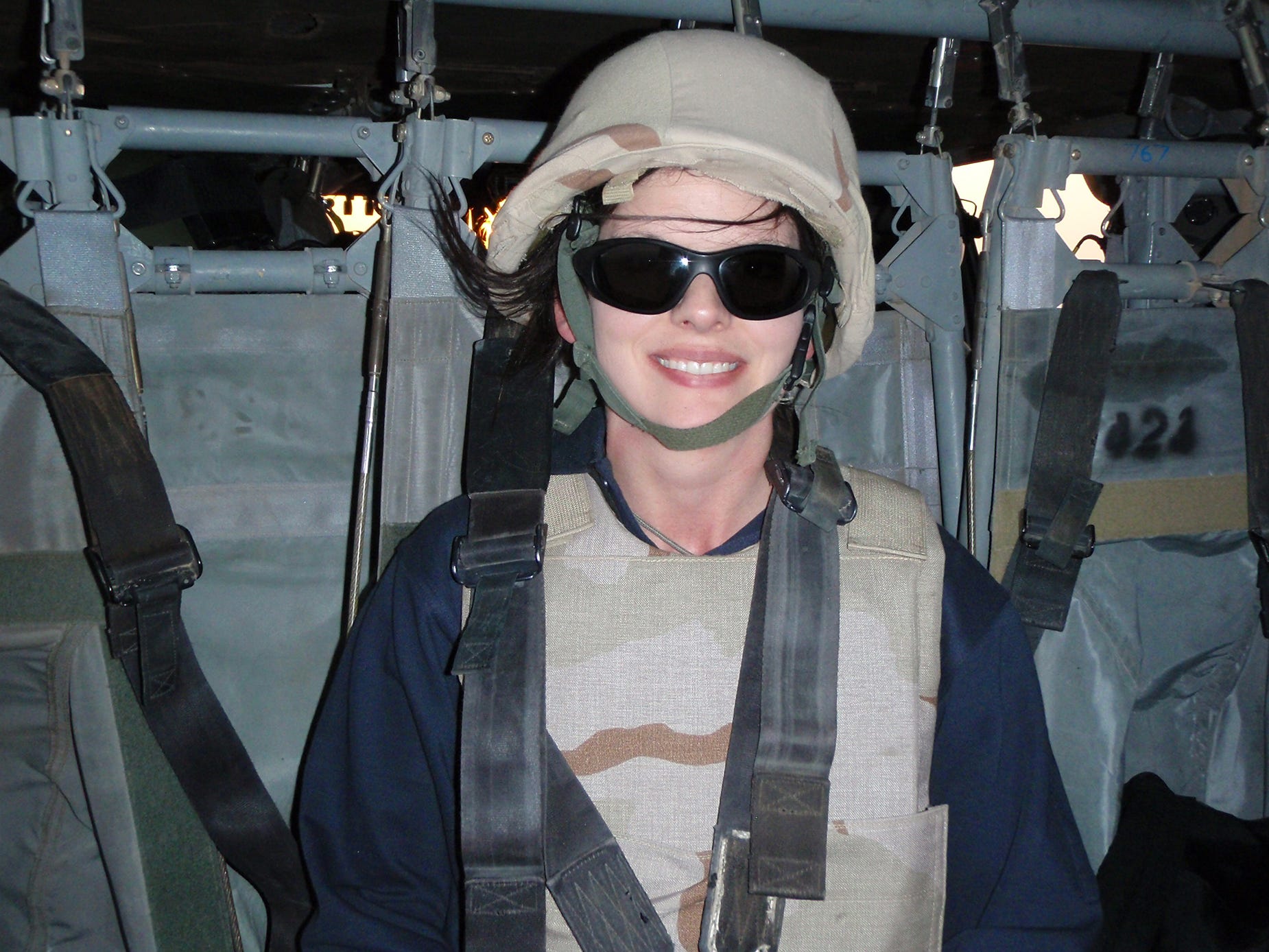
Liz has been a reporter, a CIA officer, an imagery analyst who deployed during the Iraq war, and, briefly and unsuccessfully, a teenage model. Today she’s a professor of practice at Texas A&M’s Bush School, where John is the dean. Of everything on that list, the classroom surprises her most. It took a cat to explain why.
Watch the full conversation
A paper route on the lake
She was born in Muskegon, Michigan, a blue-collar town on the west coast of the state, where kids who wanted candy from the candy store went out and earned the money. Liz delivered newspapers every day with her brothers. She loved the lake.
In the late ‘70s and early ‘80s, as the auto industry moved overseas and Michigan’s economy went with it, her family packed up for Houston. They landed in a neighborhood full of oil money, and Liz, from a lower-middle-class family with a Michigan accent, was sure she would never fit in. She did, eventually. The accent faded too, though John says it comes back when she’s mad at him and his name turns into “Jan.”
She sold shoes, luggage, and perfume at a department store. Around fourteen, with her mother encouraging her and people asking if she’d ever thought about it, she tried modeling. She was short, her hair was “out to here, because being from Houston, that’s how you did your hair,” and a friend did her makeup because she couldn’t afford a professional. At one fashion show she walked down off the platform and fell.
What ended the modeling career, though, was the attention. She didn’t like being looked at, and she worried people would think she was arrogant. “I said, I think I’m gonna focus more outward.”
The sign on the road to Kerrville
Around the same time she kept feeling sick. The aches and the exhaustion wouldn’t let up, and eventually doctors gave it a name: systemic lupus erythematosus. She remembers crying to her doctor, and she remembers what he suggested next. There was a place in the Hill Country called Texas Lions Camp, for kids with disabilities and chronic illnesses. Maybe she could go and have some fun.
It was 1982 or ‘83. Her parents drove her up to Kerrville a day early to see the place, and the sign at the entrance read Welcome to Texas Lions Camp for Crippled Children. Her mother cried when she saw it. Liz, who didn’t use a wheelchair and didn’t look sick, was afraid they would take one look at her and send her home.
Nobody sent her home. There were kids with diabetes, arthritis, and lupus, kids who used wheelchairs, and kids who couldn’t speak. A group of deaf girls started signing to her, and when they realized she didn’t know sign language, they taught her. The nonverbal campers pointed to letters on a pad. When Liz was tired or hurting, nobody asked her to explain. “They got it.”
She came back the next summer and the one after that, then became a counselor in training, then a counselor, spending two and a half months every year with children who didn’t know how long they would live or whether they would walk again. Many of them were outcasts at their high schools. At camp they canoed, played soccer, and slept outside like everybody else.
“It was always a feeling that I loved and wanted to put in a bottle and just carry it around with me.”
Outside of camp, she mostly kept the lupus to herself. The fatigue meant skipping parties and staying in on weekends, and people assumed she and John were homebodies. Sometimes she couldn’t tell whether she was depressed or just tired. “I think a lot of people suffer in silence,” she says. “Maybe to the outside world I suffered in silence, but to my friends at camp, I was able to be myself.”
❤️ 💛 In memory of Liz’s mother, Keith the Cat’s biggest fan. 🐾 🐱
Support the Keith the Cat foundation: keiththecat.org
Nosy, and good at it
She went to Texas A&M mostly because her brother and sister were already there and the siblings had to share a car. She started in special education, since that seemed like the obvious path for someone who had found her joy at Texas Lions Camp. But carrying other people’s pain every day during the school year wore her down in a way that summers never had, and she switched to journalism. The school paper hired her, and she went to every event on campus asking what was going on. “I’m nosy,” she says. “I was like, wow, I really, really like this.”
She met John at A&M. He was in the military, so she followed his postings and took jobs at small papers where a reporter also edits, lays out pages, and sells ads. She wrote about soldiers, including extensive coverage of the 24th Infantry Division and its deployments. Years later, those clips got her hired.
The push came from John. Liz was home with their two young kids, watching A Charlie Brown Christmas for roughly the fiftieth time in the middle of summer, and he could tell she was restless. He told her to apply to the CIA, which was hiring imagery analysts. She said no. She was working on her master’s and had a job at the school magazine, and she wasn’t sure she was smart enough or good enough, since she’d never been farther abroad than Canada and Mexico. He kept at her. With every round of interviews her doubts got louder, and when the offer came she asked them to wait. They gave her a month.
She cried on her first day because her kids were in daycare. Then she met the analysts and managers, people who wanted to do something good for the country, and found mentors who offered to show her how the work was done. “When you’re around people like that, it’s contagious.” When the imagery mission moved into what became the National Geospatial-Intelligence Agency, she moved with it as a CIA officer, doing work that felt like reporting for a classified audience. She stayed twenty-five years.
Somalia, and then September
Before 2001 her account was East Africa, specifically Somalia. After Black Hawk Down, colleagues told her she was wasting her time on a country nobody cared about. She kept watching anyway, because she was seeing things there.
On September 11, John was working in the White House Situation Room. Liz was at her desk, having taken the Metro in after dropping the kids at daycare. When the first plane hit, she assumed a small aircraft and a pilot’s heart attack. With the second she knew it wasn’t an accident, and when the third hit the Pentagon her knees gave out. Her manager gathered everyone and relayed what she’d heard: the Trade Center, the Pentagon, and the White House had all been hit. That last part turned out to be wrong, but Liz had no way of knowing it. She called the Situation Room and got the dead busy signal that means the line is cut, and she broke down.
A group of coworkers she barely knew circled her and started praying. At the time she wanted them out of her way. Now she wishes she could find them and say thank you, because when she called again, John’s friend picked up and told her everyone was okay.
The Metro had shut down, she had no car and no family nearby, and she hadn’t been in the area long enough to make close friends, so she called the daycare director, who hardly knew her, and asked her to keep the kids. Please don’t let them watch TV. A friend finally drove her home past the Pentagon, where she saw the smoke and felt like she was dreaming. When John got home they hugged without saying much. They took the kids to Bob Evans for dinner so everything would look normal, and the two of them sat there unable to talk.
The next day, she says, the whole country was united. She tells her students about that feeling now because she wants them to have it. One of them asked whether it would take another terrorist attack. She told them no.
After 9/11 her Somalia account took off, and so did her sense of urgency. She stopped thinking of the threats as something happening over there. She expected perfection and seriousness from the people around her and had little patience for anyone who didn’t bring it. She thinks often about the passengers on Flight 93, and about how, if that plane was headed for the White House, they may have saved John’s life. “I felt like I had to do it for them.”
What it cost
The work took a toll, and she’s candid about it. Fatigue and stress brought on depression, and some stretches of the marriage and the parenting were very hard.
One story sums up those years. Liz was presenting at a counterterrorism conference in Tampa, talking about how to fight Al-Qaeda, while John was doing “big time stuff” at the CIA. She had decided their son Bradley, about thirteen, was old enough to watch his ten-year-old sister. Then her phone rang. It was her daughter, calmly reporting that she was fine but Bradley had tied her to a tree. He’d given her water and a phone. He just wanted to go to his friend’s house without her.
Liz left the conference and called John, and though none of it was his fault, she yelled at him anyway. They hired an au pair and kept one for three years. “It wasn’t always easy,” she says, and she repeats it. What held things together was a commitment she and John made to each other to make it work.
If this story matters to you, share it with someone who needs to hear that they’re not alone in whatever they’re carrying.
The cat nobody wanted
Keith wasn’t supposed to be hers. She adopted him for Bradley, who was living on his own and seemed lonely. At the shelter Bradley picked a mellow tomcat named Bernard and renamed him Keith, for reasons nobody has ever figured out. A few weeks later he brought Keith back, saying the two of them weren’t vibing. Liz suspects Keith was just hungry.
So Liz, who had two dogs and did not consider herself a cat person, had a cat. One night he got outside after dark, and she went out on the back deck in her nightgown shouting “Keith! Keith!” into the yard. Then her neighbor’s light came on, and she remembered that her neighbor, a married man with kids, was also named Keith. She ran back inside, and Bradley laughed for a long time.
During COVID, working from home, she started posting about Keith in his own voice, and people loved it. She was attending the National War College virtually when she noticed something that didn’t look right and let it go until it became painful. It was cancer. “It’s all in my private area,” she says. “I’ll just say it’s vulvar cancer.” She tells people to Google it, then warns them to be careful what else pops up when they do.
The doctors scheduled a partial vulvectomy. Her husband and kids were scared, and she was terrified. John drove her to appointment after appointment and waited in the lobby while she went through the scans and procedures alone on the other side of the door. At home there was a cat who seemed to know. Keith napped with her, watched TV with her, and wouldn’t leave her side.
That’s how she ended up in the scanner thinking about him.
She and John put Keith’s picture on a T-shirt that said You’ve been CAT scanned, and she started giving them to people going through cancer. Each shirt came with a letter from Keith explaining that he had been with Liz through her treatments and would be with the wearer too. Then the requests widened: a mother whose daughter was being bullied, a parent whose kid felt left out. When the Shermans moved to College Station and friends there started asking for shirts, Liz wondered why this shouldn’t be a nonprofit.
She recruited three people. Her daughter, a social worker, makes sure everything Keith says is age-appropriate. Her daughter-in-law, an HR expert, runs operations. Michael Smith in Detroit, who ran her father’s campaign for state senate when Liz was a little girl, knows how to raise money. Liz was a little embarrassed at first, since it was a cat, after all. The board is not. “You would think we were at a CIA meeting discussing an invasion or something,” she says. Once, when she estimated the cost of merchandise as “around” a number, her daughter-in-law stopped her: they needed the real price or the model wouldn’t work.
Keith the Cat now sends shirts, socks, and hats (hospitals are cold) and care packages free to anyone going through cancer, and runs a blog about Liz’s journey and other people’s. The blog covers the practical questions too: what to bring to the hospital, what to say to someone who has cancer, and what not to say.
Tired of her own story
As of this conversation, Liz has had thirteen surgeries, and her fourteenth was scheduled for the following Monday. She says you can only have so many vulvectomies, and she is at that stage.
For a while she wrote updates on CaringBridge about her pain and her struggles. Eventually she got tired of listening to herself. Everyone knew she was hurting, and she knew cancer from every side. A brother died of it at seven, when she was a baby, and her mother, who was fighting cancer when we spoke, has since passed away. “Cancer sucks,” she says. She wanted to talk about something that might make someone smile, and Keith gave her that.
Her mother, Judy, was a musician, an artist, a dancer, and an actress, and her love for God ran through all of it. She and Liz’s father were married sixty-five years and raised their family together. Liz believes the creativity that turned a CAT scan into Keith the Cat came from her. “She was my greatest fan and was proud of everything I did,” Liz says. Judy loved Keith and encouraged her daughter to keep the nonprofit going, and Liz takes comfort in picturing her now with her firstborn, the son cancer took at seven.
Her own hope comes from God and from Jesus, and she’s open about that. She’s also traveled the world enough to know that not everyone believes, and she wanted a symbol anyone could hold onto. Keith, the animal she loves and who loves her back, felt safe for everyone.
As a former journalism major, she admires MD Anderson’s logo, where the word cancer is struck through with an editor’s line. She wants Keith’s logo, a paw with a heart, to work the same way, so that when people see it they think hope. What the organization needs now is modest: a few sponsors to cover the cost of items that go out free, and perhaps a steady client, like a medical facility, a Ronald McDonald House, or a small-town clinic that wants care packages on a regular basis.
“As long as people are asking,” she says, “I’m gonna keep doing it.”
Back in the classroom
When the Shermans moved to College Station, the Bush School had professors of practice from the CIA, FBI, and NSA but nobody from NGA, and hardly anyone knew what geospatial intelligence was. Liz agreed to teach it and partnered with the geography department. She didn’t expect to like it.
Her students have tested her patience. One told her he had no idea why he was in her class. Others email to ask, in one line, how to get into the CIA. One turned down a CIA job offer because Washington, she insisted, doesn’t have good Mexican food. Liz laughed, thinking it was a joke, and then realized the student was completely serious.
Mostly, though, the students give her hope. They want to serve and to do something good, and they don’t seem to be taking part in the country’s divisions. When Savan asked what she hoped someone would take from this conversation twenty years from now, she answered before he had finished the question.
“Service. Service to country, service to God, service to each other. Don’t lose hope. We’re never really alone in our struggle.”
That community, she says, may come from places you’d never expect: a summer camp with a hard word on its sign, a spy agency, a cat who was supposed to be her son’s. The girls at Texas Lions Camp taught her sign language because she couldn’t speak theirs. Forty years later, the letter tucked into every Keith the Cat package tells a stranger the same thing those girls told her.
“No matter how hard things get,” Liz says, “service is what will make us get through this.”
❤️ 💛 In memory of Liz’s mother, Keith the Cat’s biggest fan. 🐾 🐱
Support the Keith the Cat foundation: keiththecat.org
Support LBT
☕ Buy Me a Coffee · 📖 Get the LBT Book
Listen to Life Between Titles
·📺 YouTube · 🟢 Spotify · 🍎 Apple Podcasts · 🎵 Amazon Music
Join the Community
📝 Substack · 📸 Instagram · 💼 LinkedIn
Partner with LBT
💰 Become a Sponsor · 🙋 Nominate a Guest
As a former colleague, what a great story and even better person.