

The Protector
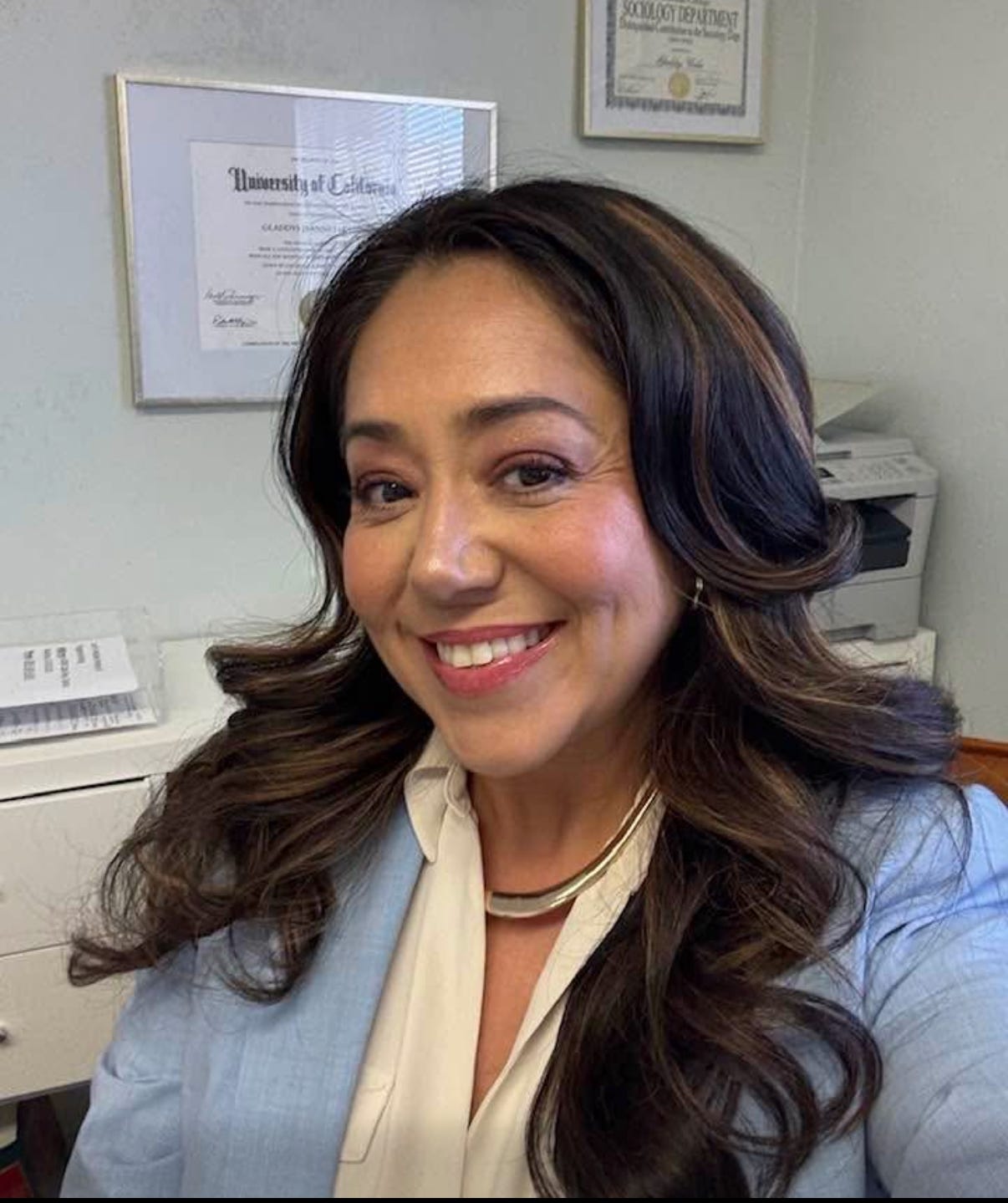
Gladdys Uribe has been fighting for immigrants her whole career. Right now, that fight has never been harder.

Gladdys Uribe decided at sixteen that she was going to become a civil rights attorney.
That was the plan. Everything after was preparation.
Occidental. UCLA Law. A Chicano civil rights firm in Los Angeles. A bootcamp of an immigration practice where they took shots every time they won a case. A solo firm she built herself when nothing else fit what she needed as a mother and an advocate.

Thirty years of moving in one direction.
“I’m living my purpose,” she says. “It’s a natural progression.”
That’s a sentence most people spend decades trying to say. Gladdys says it like it’s just a fact.
The Daughter of Immigrants
Gladdys grew up in Southern California, the daughter of Mexican immigrants who came to this country with nothing and built a life anyway. Her father had a sixth-grade education. Her mother graduated high school. When Gladdys was born, her dad was undocumented. He got his residency through her mother when Gladdys was two.
She grew up working poor, surrounded by a sprawling extended family. Her dad was one of fourteen. Her mom was one of ten. Cousins everywhere, spread across Salinas and Santa Barbara County.

Gladdys was the first girl in her extended family to graduate high school.
It wasn’t really a thing for Mexican girls to go away to college. But she had a sense of fairness and justice that had been alive in her since she was a kid, sharpened by watching her family navigate a system that wasn’t built for them. She wanted every legal tool available to fight back.
She was offered a scholarship to Dunn School, a boarding school in Los Olivos, California. Teachers pulled her aside. One handed her a book on Chicano history. Another introduced her to the writer Gloria Anzaldúa. Each thing she read, she understood as preparation.
“I felt like everything was adding tools to my toolkit,” she says. “Because I did have that ultimate goal.”
Oxy, by Accident
When it came time for college, money decided. Gladdys got a full ride to Trinity College in Connecticut and thought she’d thrive far from home.
She lasted two weeks.
“I needed all of my hundred and fifty, hundred and seventy-five cousins and family members,” she says. “So I left.”
Her mother was furious. They’d spent a whole year convincing her father to let Gladdys go in the first place. So for that first semester, Gladdys was grounded. Work and home. Nothing else.
Desperate to get out of the house, she called every California school that had already accepted her. Occidental said yes for the spring semester.
The day she toured Oxy, she’d also toured UCLA and left her purse at the water cooler. Cash inside. Someone returned it.
“And I took that as a sign,” she says.
She showed up in the spring knowing no one, convinced everyone had already made their friends. She made herself annoyingly outgoing. She introduced herself to strangers. She pushed.
That’s how she ended up at a school that, as she describes it, wasn’t just about churning out students. It was about creating responsible, engaged citizens of the world.
It was the right place.
The Weight of Law School
UCLA Law was a different kind of challenge.
Not just the workload. The environment itself was hostile in ways Gladdys hadn’t anticipated.
“Not very many students of color,” she says. “Just people who came from families of generations of lawyers.”
One of her first-year professors was known for publishing something called the Mismatch Theory, which argued that elite law schools were actually harming students of color by admitting them — that they didn’t belong there, that they’d be better served at second-tier schools. That professor taught her property class.
“It was very challenging,” she says. “And painful.”
The study of law, she came to understand, was largely the study of how power was codified and protected. The first case taught in law school is about how Europeans took land from Native Americans and used legal frameworks to justify it.
“It’s the study of white supremacy,” she says plainly.
What got her through was community. A small, fierce group of Latino students and students of color who looked out for each other from day one. Concentrations in critical race studies and public interest law that gave the abstract a purpose. And, for the first time in her life, therapy.
“It was like the very first time that I had paid attention to my mental health,” she says.
As a student, she won an asylum case for a gay man from El Salvador who had survived sexual abuse and government persecution and was sitting in immigration detention while she fought for him.
“It’s intoxicating,” she says. “It’s emotional. It’s beautiful.”
She graduated. She kept going.
Built to Last
Her first job out of law school was at a Chicano civil rights firm in Los Angeles. She was the only immigration attorney there and had no one to learn from.
So she found someone. She made herself business cards as a law student and handed them out at every Mexican American Bar Association event, every Latina Lawyers gathering. She tracked down Enrique Arevalo, one of the most respected immigration attorneys in Los Angeles, and just kept at him. Cards. Follow-ups. Reminders. After about a year, he brought her on.
His office was known as immigration bootcamp. The best people in the field had come through there. Gladdys sat around a table with five other attorneys talking case strategy, and they took shots every time they won. They went on retreats to Costa Rica, to Mexico. She made some of her best friends in that room.
As a baby lawyer, she remembers being so anxious before her first court appearances, that she would run to the bathroom, throw up, and then walk back out.
Then she got married, got pregnant, and understood the pace wasn’t sustainable anymore.
She tried being a stay-at-home mom. Lasted six months.
“I learned that’s the hardest job in the world,” she says. “Nobody pays you for it. It’s not really appreciated. I love this kid, but I can’t be with her 24/7.”
So she built her own firm. Not because she always wanted to run her own practice, but because the spaces that existed didn’t fit what she needed as a mother and an advocate. She shares an office with a UCLA law school classmate. There’s a conference room with coloring books and a television for when the kids need to come in.
“I created the job that I wanted and I needed,” she says. “Because the spaces don’t necessarily exist for us.”
Saying Yes Instead
About a year and a half ago, Gladdys started asking herself a question before turning anything down.
Am I saying no because of fear?
If the answer was yes, she made herself say yes instead.
Telemundo asked her to come in and do immigration legal commentary. She’d been asked before and always found a reason to decline. What if she used the wrong word in Spanish? What if she said something wrong on air?
She went. They asked her back. Now she rotates every other week.
“Really good things started happening for my career once I made myself say yes,” she says.
She still gets nauseous before court. Has since her first year. She walks in, goes to the bathroom, throws up, and then walks back out.
“Eye of the tiger,” she says. “Let’s go.”
The Crack in Hope
This is the part of the conversation that stays with you.
Gladdys works with clients who came to the United States holding America on a pedestal. A place with rule of law. A place where if you worked hard, your children would have better lives. A place where no one was above the law, not even the president.
That last one is literally a question on the citizenship test. Gladdys sits across from clients and helps them prepare to answer it.
“My clients have to sit there and say the rule of law is that no one is above the law, not even the president,” she says. “It f***ing kills me.”
During the ICE raids in Los Angeles, the city emptied out. School enrollment in LAUSD dropped by roughly twenty percent. Street vendors disappeared. Businesses closed. Downtown became a ghost town.
“My people have a really, really strong work ethic,” she says. “For my community not to show up to work is next level crazy.”
She made her own children start carrying their passports. Her teenager is developing her political opinions and having real conversations. Her eight-year-old has strong thoughts about Donald Trump that Gladdys has to remind her to keep at home.
More and more, she says, her clients ask the same question: how is he getting away with all of this? Why isn’t anybody stopping him?
She doesn’t have an easy answer. She keeps going anyway.
What She Tells People
If you get detained, memorize a phone number before they take your phone. Memorize your alien registration number, your A number, because without it, they can’t find you. Some immigration attorneys are now telling their clients to put an AirTag in their shoe.
ICE facilities are almost always in remote rural areas. That’s not an accident. It’s to isolate people from family, from legal counsel, from anyone who might help.
“People have been lost for weeks,” she says. “Their families don’t know where they are.”
What gives her hope is her community. Organizations like the ACLU, CHIRLA, and MALDEF filing lawsuits against the government. The kids, who are paying attention. And something she didn’t see coming: Americans with no direct stake in any of this waking up and showing up.
Neighbors driving immigrant kids to school so parents don’t have to go out. Grocery drops. Whistles worn around necks to signal when ICE is nearby.
“I’ve seen people that don’t necessarily have skin in the game start to wake up,” she says. “That gives me hope.”
What She Hopes Her Girls See
At the end of our conversation, I ask Gladdys what she hopes her daughters get from watching this interview twenty years from now.
She pauses. Then:
“It’s up to each generation to continue to fight. And to make things better for those that are coming after us. To protect people. To take care of people. It just goes back to being a good human being.”
One more beat.
“If you see an injustice against somebody, it’s important to fight for them.”
Gladdys Uribe has been doing exactly that since she was sixteen years old. She’s not stopping now.
Gladdys Uribe is an immigration attorney and legal commentator based in Southern California. Follow her work and find her commentary on Telemundo and Univision.
Support LBT
☕ Buy Me a Coffee
Listen to Life Between Titles
·📺 YouTube · 🟢 Spotify · 🍎 Apple Podcasts · 🎵 Amazon Music
Join the Community
📝 Substack · 🎵 TikTok · 📸 Instagram · 💼 LinkedIn
Partner with LBT